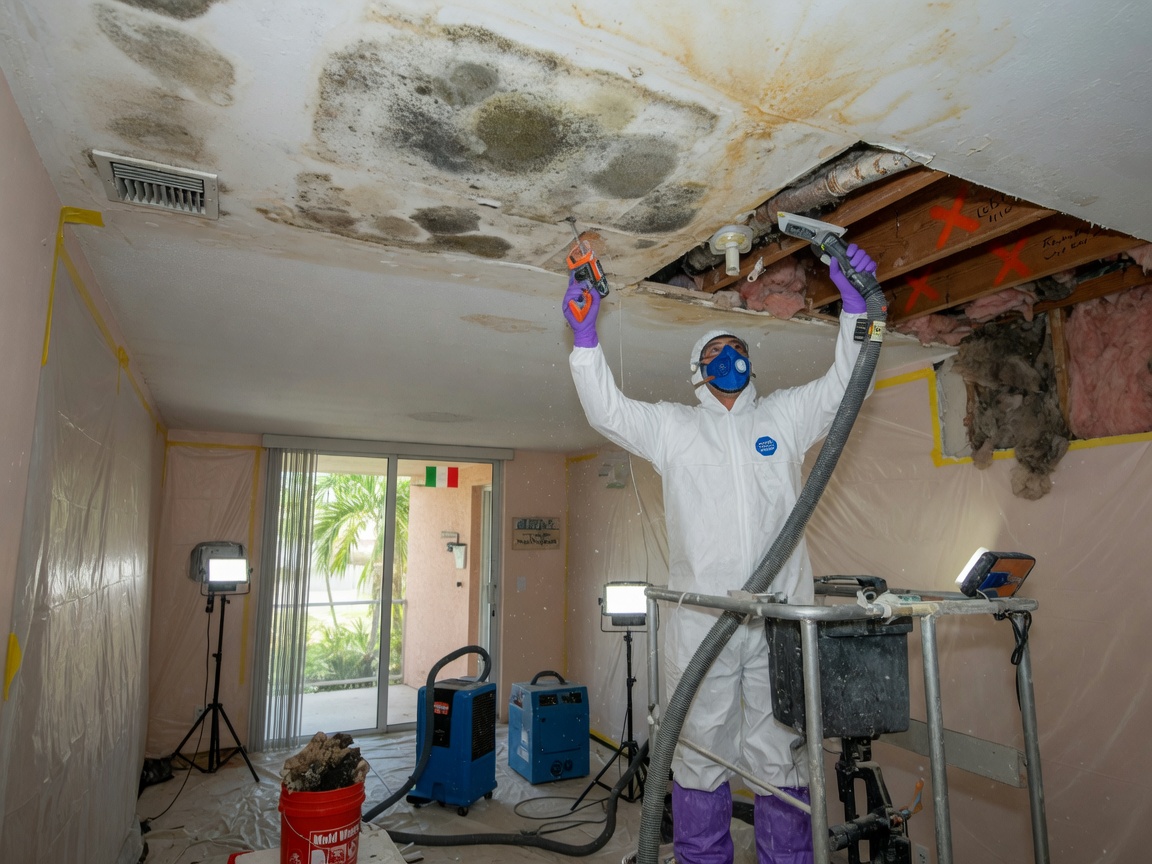
Naples homes built before the 1980s in Old Naples and near Fifth Avenue South often feature plaster-over-lath ceilings that trap moisture from the area’s warm winters and frequent afternoon showers. When roof leaks or AC condensation reach these ceilings, mold spreads along the lath channels and into adjacent joist bays, requiring selective removal rather than full demolition to preserve historic finishes.
In Port Royal and Aqualane Shores waterfront properties, high water tables and storm surge push humidity upward through slab-on-grade construction, feeding mold on the underside of second-floor ceilings. Technicians must map HVAC returns that pull air across these surfaces, because simply treating visible growth without sealing duct paths allows spores to recirculate once the system restarts.
Collier County building practices in newer sections near Third Street South use moisture-resistant drywall, yet the same tropical savanna climate still drives condensation at can-light penetrations and recessed speaker cutouts. Removal crews isolate these zones with negative air and HEPA filtration to prevent cross-contamination into living spaces below, then apply antimicrobial coatings rated for high-humidity environments before refinishing.
Access limitations in multi-story homes near Naples Pier often require scaffolding or lift equipment rather than ladders, and crews coordinate with electricians to de-energize circuits before disturbing ceilings that may contain knob-and-tube wiring still present in some Downtown Naples blocks.
Technician insight
In Naples the thing that catches most people out with Ceiling Mold Removal is the way warm winter nights keep attic temperatures above the dew point even when the AC is off, so condensation keeps forming on plaster ceilings in Old Naples homes long after the visible leak is fixed.
Port Royal Second-Floor Ceiling
A homeowner noticed dark staining on a bedroom ceiling after a heavy rain. Inspection found elevated moisture in the plaster from a roof valley leak that had wicked along joists. Crews contained the room, removed the affected section, treated the framing, and dried the cavity over three days before the ceiling was ready for new plaster.
Ceiling Mold Removal Services We Offer
✓Plaster Ceiling Mold Remediation
Removes mold from historic plaster ceilings in Old Naples homes while preserving lath integrity and avoiding full replacement that would alter original architectural details.
✓Drywall Ceiling Mold Removal
Cuts out and replaces affected drywall sections in newer Collier County homes, treating joist cavities to stop regrowth driven by AC condensation or roof leaks.
✓Attic Ceiling Mold Treatment
Addresses mold on the underside of roof decks and ceiling joists common after summer rains in Port Royal and Aqualane Shores properties with limited ventilation.
✓HVAC-Linked Ceiling Mold Remediation
Targets mold growth on ceilings near supply vents caused by humid air from coastal Marco Island and Bonita Springs infiltration in Collier County homes.
✓Recessed Light Mold Cleanup
Removes mold around can lights and speaker cutouts where warm moist air condenses against cooler attic spaces in Downtown Naples residences.
Ceiling Mold Removal Cost in Naples, FL
| Service | Typical Range | What Affects It |
|---|---|---|
| Small isolated ceiling patch | $450–$850 | Single room, plaster or drywall, ground-floor access |
| Full-room ceiling remediation | $1,200–$2,400 | Includes containment, treatment, and drying; higher in two-story homes |
| Attic underside treatment | $900–$1,800 | Per 200 sq ft; affected by roof pitch and insulation depth |
| HVAC-adjacent ceiling work | $650–$1,100 | Requires duct sealing; price rises with multiple vents |
Ranges are typical for Naples, FL and confirmed with an exact written quote before any work starts.
How it works
- 1
Moisture Mapping and Containment
Technicians use moisture meters and thermal imaging to locate hidden water in ceilings across neighborhoods like Old Naples, then seal the work area with plastic sheeting and negative air machines.
- 2
Selective Demolition
Affected plaster or drywall is removed in controlled sections, with debris bagged inside the containment zone to prevent spores from reaching other rooms or the street level near Fifth Avenue South.
- 3
Antimicrobial Application and Drying
EPA-registered treatments are applied to exposed framing, followed by commercial dehumidifiers and air movers until wood moisture content returns to acceptable levels for the local climate.
- 4
Final Clearance and Refinishing Prep
Independent air sampling confirms spore counts match outdoor baselines before the ceiling is prepped for new finishes, with homeowners given a written report for insurance documentation.
Pricing
Cost depends on ceiling access, material type, and square footage; upfront quotes are provided after inspection at the Rosemeade Lane address.